
Credit Utilization: How It Affects Your Score & Borrowing
Table of Contents
- The Mechanics of Credit Utilization
- How Credit Utilization Influences Your Credit Score
- Aggregate vs. Per-Card Utilization: Which Matters More?
- The 30% Threshold Myth vs. Optimal Ranges
- Timing the Market: Statement Dates vs. Due Dates
- Risks to Your Borrowing Power
- Strategies for Optimizing Your Utilization Ratio
- Common Mistakes That Tank Your Score
- Frequently Asked Questions
- Final Analysis
The Mechanics of Credit Utilization
Consider a borrower applying for a mortgage with a stable income and a flawless payment history. On paper, they look ideal. However, a closer look at their liabilities reveals three credit cards with a combined limit of $10,000 and current balances totaling $9,000. To a mortgage underwriter, this is not merely a debt volume issue; it is a critical risk signal. High credit utilization suggests a reliance on revolving credit to fund daily operations, which significantly increases the probability of default should an economic shock occur.
Credit utilization is the ratio of your current revolving credit balances to your total available credit limits. It differs fundamentally from installment loans, such as a fixed-rate mortgage or an auto loan, where the principal is amortized over a set term. Revolving credit allows a borrower to draw funds, repay them, and draw again. Because these balances fluctuate constantly, lenders use the utilization rate as a proxy for financial stress and liquidity.
This metric is a primary component of the scoring models developed by FICO and VantageScore. It provides a real-time snapshot of how much of your financial safety net has been consumed. When a borrower maximizes their limits, they leave themselves no margin for emergencies, which classifies them as a higher-risk profile in the eyes of institutional lenders and the Federal Reserve’s regulatory framework for risk management.
Quick Facts
| Feature | Detail |
|---|---|
| Asset Type | Revolving Credit (Credit Cards, HELOCs) |
| Primary Impact | Credit Score Volatility |
| Ideal Range | Under 10% |
| Update Frequency | Monthly (typically) |
| Primary Goal | Lower interest rates and higher loan approvals |
How Credit Utilization Influences Your Credit Score
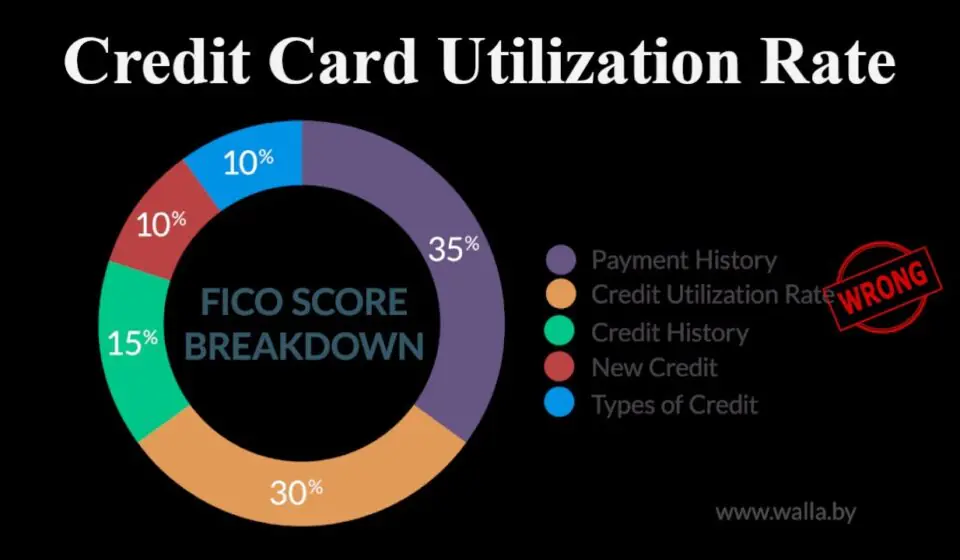
In the architecture of a credit score, utilization acts as a volatility amplifier. While payment history remains the most significant factor in determining a score, utilization is often the second most influential. The reason is its fluidity. A single large purchase on a credit card can spike utilization and trigger a score drop overnight, whereas a positive payment history takes years of consistency to build.
Lenders interpret a high utilization rate as credit hunger. In risk analysis, a borrower who consistently operates near their credit ceiling is statistically more likely to miss a payment than one who uses only a fraction of their available credit. This correlation is why credit scores react so sharply to balance fluctuations.
The relationship between utilization and score impact is non-linear. Reducing utilization from 90% to 70% may result in a modest score increase. However, moving from 30% down to 9% often triggers a more significant jump. This shift signals a transition from a stressed credit profile to one characterized by disciplined management.
The Mathematical Impact on Borrowing Power
When applying for a loan, lenders evaluate more than just a three-digit score; they analyze the debt-to-income (DTI) ratio alongside utilization. High utilization increases the perceived risk of over-extension. If a borrower is utilizing 80% of their available credit, a lender may conclude that any further borrowing will push the individual past their breaking point. This often results in the loan being denied or the borrower being hit with a higher interest rate to compensate the lender for the increased risk of default.
Aggregate vs. Per-Card Utilization: Which Matters More?
Many borrowers mistakenly focus only on their total credit limit across all accounts. While the aggregate ratio is critical, the distribution of debt across individual cards—known as per-card utilization—is equally vital for a top-tier score.
The Aggregate Perspective
Aggregate utilization is the sum of all revolving balances divided by the sum of all credit limits. For example, if you hold three cards with limits of $5,000 each (Total $15,000) and your total debt is $3,000, your aggregate utilization is 20%. This provides the broad signal lenders use to gauge overall credit health and general solvency.
The Per-Card Perspective
Per-card utilization examines each account in isolation. Consider a borrower with a $10,000 total limit across three cards. If they carry a $3,000 balance spread evenly ($1,000 per card), their per-card utilization is 10% for each. However, if that $3,000 balance is concentrated on a single card with a $3,000 limit, that specific card is at 100% utilization.
Even though the aggregate utilization remains 30% in both scenarios, the latter is far more damaging. A maxed-out card is a red flag for credit scoring algorithms. It suggests a lack of liquidity or an inability to manage a specific line of credit, even if other accounts remain empty. To maximize a score, borrowers must avoid maxing out any single card, regardless of how low their overall aggregate utilization may be.
The 30% Threshold Myth vs. Optimal Ranges
For years, conventional financial wisdom suggested keeping credit utilization below 30%. While 30% serves as a reasonable ceiling to prevent severe score degradation, it is far from the optimal target for those seeking an elite credit profile.
The 30% Ceiling
The 30% rule is a general guideline for the average consumer. Staying under this mark typically prevents a borrower from being flagged as high risk. However, for advanced borrowers or those preparing for a major loan application—such as a mortgage from a bank regulated by the Federal Reserve—30% is often too high to secure the most competitive rates.
The Optimal <10% Range
Empirical data from scoring models indicates that the highest scores are typically associated with utilization rates under 10%. In many cases, the sweet spot resides between 1% and 9%.
One might ask why 0% is not the ideal. Interestingly, some scoring models may penalize a borrower who shows 0% utilization across all accounts. This is interpreted as credit inactivity. Lenders want to see that a borrower can use credit responsibly and manage repayments, rather than avoiding credit entirely. A small, active balance that is paid in full every month is often more beneficial than total inactivity.
| Utilization Range | Risk Perception | Likely Score Impact |
|---|---|---|
| 0% | Inactive | Neutral to Slight Dip |
| 1% – 9% | Disciplined | Maximum Positive Impact |
| 10% – 29% | Moderate | Positive to Neutral |
| 30% – 49% | Warning | Potential Moderate Dip |
| 50% + | High Risk | Significant Negative Impact |
Timing the Market: Statement Dates vs. Due Dates
A common point of confusion for borrowers is the distinction between the statement closing date and the payment due date. This nuance is where many disciplined payers lose points on their credit score.
The Statement Closing Date
The statement closing date is the day the credit card issuer snapshots your balance and reports it to the major credit bureaus, including Equifax, Experian, and TransUnion. If your balance is $2,000 on the closing date, that is the figure reported to the bureaus, regardless of whether you pay it off two days later.
The Payment Due Date
The due date is simply the deadline to avoid late fees and interest charges. If your statement closes on the 1st of the month and your payment is due on the 25th, paying on the 25th means you have been reported to the bureaus with a high balance for nearly the entire month.
The Payment Lag Strategy
To optimize a score, payments must be made before the statement closing date. By reducing the balance to under 10% before the issuer generates the statement, you ensure that the credit bureaus receive a low utilization figure. This allows a borrower to use credit for daily expenses while maintaining the appearance of low risk on their credit report.
Risks to Your Borrowing Power
Credit utilization is not a static number; it is subject to the internal risk appetites of the lenders who provide the credit. This introduces variables outside the borrower’s direct control.
The Danger of Credit Limit Decreases
Lenders periodically review their portfolios to manage risk. If a bank observes a macroeconomic downturn or a negative change in your credit profile, they may unilaterally decrease your credit limit.
Consider a borrower with a $5,000 balance on a $10,000 limit (50% utilization). If the bank suddenly slashes the limit to $6,000, the borrower’s utilization instantly jumps to 83%, even though no additional spending occurred. If this happens immediately before a mortgage application, it can lead to a sudden score drop and a higher interest rate on the home loan.
The Correlation with Liquidity
High utilization is often a symptom of a liquidity crunch. When a borrower uses credit to cover basic living expenses, they are effectively trading future income for present consumption. This increases the basis risk of their personal finances. If the borrower loses their primary income stream, high utilization ensures they have no remaining credit capacity to lean on, accelerating the path toward insolvency.
Strategies for Optimizing Your Utilization Ratio
Optimizing utilization requires a tactical approach to balance management and lender interaction.
Requesting Limit Increases
The fastest way to lower a utilization ratio without paying down debt is to increase the denominator—the total credit limit. By requesting a limit increase, you immediately lower the percentage of use.
This must be handled with caution. Some lenders perform a hard pull on the credit report to approve an increase, which can cause a temporary, minor dip in the score. Borrowers should explicitly ask the issuer if the request will result in a hard inquiry. If it is a soft pull, the increase is a pure win for the utilization ratio.
Strategic Debt Shifting
If one card is nearly maxed out while another is empty, shifting the balance can improve per-card utilization. While this does not change the aggregate ratio, it removes the red flag of a maxed-out account.
The Micro-Payment Approach
Instead of making one large payment per month, consider making several smaller payments throughout the billing cycle. This ensures that no matter when the statement closes, the balance is kept at a minimum. This is particularly useful for high-spenders who do not want to carry a large balance into the reporting period.
Common Mistakes That Tank Your Score
Even disciplined borrowers can make errors that negatively impact their utilization metrics.
Closing Old Accounts
Closing a credit card account may seem like a responsible way to simplify finances, but it often backfires. When an account is closed, the associated credit limit is removed from the total. If you have $2,000 in debt on other cards, losing a $5,000 limit from a closed account will cause your overall utilization percentage to spike.
Over-Reliance on Buy Now, Pay Later (BNPL)
While many BNPL services do not report to credit bureaus in the same way as revolving credit, some are beginning to do so. If these loans are categorized as revolving credit, they can unexpectedly increase utilization. Borrowers should verify how any new credit product is reported according to Consumer Financial Protection Bureau (CFPB) guidelines.
Ignoring the Balance Transfer Trap
Balance transfers can be a tool to lower interest costs, but they can also lead to higher utilization if mismanaged. Moving debt from one card to another does not reduce the total debt; it merely changes its location. If the new card has a lower limit than the original, utilization on that specific card will skyrocket, potentially offsetting the benefits of the lower interest rate.
Frequently Asked Questions
How does credit utilization affect my credit score?
Credit utilization measures how much of your available revolving credit you are currently using. High utilization signals to lenders that you may be over-extended and are at a higher risk of default, which typically leads to a lower credit score. Conversely, low utilization suggests financial discipline and a lower risk profile, which increases your score.
What is a good credit utilization ratio?
While staying under 30% is a general guideline for the average consumer, the most competitive scores are typically held by those with a ratio under 10%. For maximum borrowing power and the best possible interest rates, aim for a range between 1% and 9% across both your aggregate and per-card limits.
Why did my score drop after I paid off my balance?
This is a rare but possible occurrence known as the zero balance effect. Some scoring models view 0% utilization across all accounts as a lack of credit activity, which can lead to a slight dip. A small, managed balance that is paid consistently is often viewed more favorably than total inactivity.
When does credit utilization update on my credit report?
Utilization typically updates once a month, usually shortly after your statement closing date. It does not update in real-time every time you make a purchase or a payment. This is why timing your payments to occur before the closing date is critical for score optimization.
Can a 0% balance hurt my credit score?
It generally will not hurt your score in a significant way, but it may prevent you from reaching the absolute highest possible score. Lenders prefer to see that you use credit and pay it back consistently rather than not using it at all.
Is it better to have a high limit or low utilization?
Both are beneficial, but they serve different purposes. A high limit provides a larger safety net and makes it easier to maintain low utilization. However, the scoring model cares about the ratio (utilization), not the absolute dollar amount of the limit.
Final Analysis
Credit utilization is a mathematical signal of risk. By understanding the distinction between aggregate and per-card ratios and timing payments to precede the statement closing date, you can effectively engineer a higher credit score. The goal is not merely to avoid debt, but to demonstrate a sophisticated ability to manage revolving credit without relying on it for survival.
As a practical next step, review your most recent credit statements to identify your statement closing dates. Adjust your payment schedule to ensure your reported balances are below 10% of your limits.
Keep in mind that while optimizing utilization can boost your score, it is only one piece of the puzzle. Consistent payment history and a diverse mix of credit types remain the foundation of long-term creditworthiness. Market conditions and lender criteria can change, so maintain a conservative approach to borrowing regardless of your available limits.
—
This article is for educational purposes only and does not constitute investment or financial advice. Trading and borrowing carry risk of loss; never commit to financial obligations that exceed your ability to pay.
Editorial Byline: Senior Financial Editor
Last reviewed: August 2026