

Table of Contents
- Why JM Bullion’s Pricing Engine Matters
- Spot Price vs. Premium: The Core Mechanics
- Product-Type Premium Structures
- Volume-Based Pricing Tiers and Breakpoints
- Bid-Ask Spread Dynamics on Buy vs. Sell Orders
- Live Price Updates and the Sunday Evening Lock Window
- Locking In a Price Before Funds Settle
- Buyback Pricing Compared to Local Coin Shops
- Common Mistakes That Increase Your Cost Basis
- Frequently Asked Questions
- Conclusion
Why JM Bullion’s Pricing Engine Matters
Physical gold investors learn quickly that the headline spot price is only the starting point. What actually hits your account is spot plus a premium — and that premium varies by dealer, product, quantity, and even the hour you place the order. JM Bullion, one of the largest online precious metals retailers in the United States, publishes a live pricing feed that updates every few seconds during market hours. Understanding how their engine calculates the final price per ounce can save you meaningful basis points on every transaction.
The difference between paying a $42 premium on a 1 oz Canadian Maple Leaf and a $38 premium on a 10 oz bar may seem small on a single purchase. On a $50,000 allocation, those few dollars per ounce compound into hundreds of dollars — money that stays in your pocket instead of the dealer’s margin. This guide breaks down the three levers that drive JM Bullion’s final price: product-tier premiums, volume breakpoints, and the bid-ask spread you navigate when buying versus selling back.
By the end, you’ll know how to read the live feed, when to hit the “price lock” button, and how to structure orders so the effective cost per ounce stays as close to spot as the market allows.
The Spot Reference Point
JM Bullion anchors its pricing to the CME Group COMEX gold futures front-month contract, the same benchmark used by wholesale dealers, ETFs, and central banks. The feed updates continuously from Sunday 6:00 p.m. ET through Friday 5:00 p.m. ET, pausing only for the daily 45-minute settlement window at 5:00 p.m. ET. When you see “Spot: $2,350.00” on the site, that number reflects the most recent COMEX print adjusted for the current bid-ask spread in the wholesale market.
How the Premium Layer Works
The premium covers minting, logistics, insurance, dealer overhead, and profit margin. JM Bullion publishes it as a flat dollar amount per unit (e.g., “+$42.00 over spot” for a 1 oz American Gold Eagle). The premium is not a percentage; it stays fixed in dollar terms even if gold trades at $1,800 or $2,500. That means the premium’s percentage impact shrinks as spot rises — a structural advantage for buyers during bull markets.
Key Takeaway: Always calculate your all-in cost as (spot + premium) × quantity + shipping/insurance. The premium is the only component you can influence through product choice and order size.
Spot Price vs. Premium: The Core Mechanics
The relationship between spot and premium functions like a two-layer cake. The bottom layer — spot — moves with global futures markets, driven by macro forces: Federal Reserve policy expectations, dollar index fluctuations, real yields on Treasury Inflation-Protected Securities, and geopolitical risk premiums. The top layer — premium — reflects product-specific supply chains, mint capacity constraints, and dealer inventory positioning.
When the COMEX front-month contract prints $2,350, that price represents wholesale delivery of 100-ounce good-delivery bars in New York vaults. A 1 oz American Gold Eagle carries additional costs: the U.S. Mint’s fabrication charge, authorized purchaser markups, shipping from West Point to dealer warehouses, insurance in transit, and the retailer’s operating margin. JM Bullion bundles those into a single per-unit dollar figure.
Critically, the premium does not scale with spot. If gold rallies from $2,000 to $2,500, a $42 premium drops from 2.1% to 1.68% of the all-in price. That dynamic rewards holders during sustained uptrends — the fixed dollar premium becomes a smaller drag on total return. Conversely, in a declining market, the same premium represents a larger percentage hurdle to break even.
Product-Type Premium Structures
Government-Minted Bullion Coins
Coins produced by sovereign mints — American Gold Eagles, Canadian Maple Leafs, South African Krugerrands, Austrian Philharmonics — carry the highest premiums. The U.S. Mint charges authorized purchasers a fixed markup over spot for Eagles; that cost flows through to retailers. Maple Leafs and Philharmonics typically sit $2–$5 lower per ounce than Eagles because the Royal Canadian Mint and Austrian Mint operate with thinner wholesale margins.
Concrete example: At a $2,350 spot, a 1 oz Eagle might show +$48, a Maple Leaf +$42, and a Philharmonic +$40. The $8 spread between Eagle and Philharmonic is pure product-tier premium — same gold content, different mint economics. Krugerrands often trade near the Philharmonic level, though supply can be less consistent depending on South African Mint export allocations.
The premium hierarchy reflects more than mint pricing. Legal-tender status creates seigniorage — the government captures the difference between face value and intrinsic metal value. Eagles carry a $50 face value; Maple Leafs, $50 CAD; Philharmonics, €100. That sovereign backing translates to universal recognition, tighter buyback spreads, and eligibility for precious metals IRAs under IRS guidelines.
Generic Rounds and Private-Mint Bars
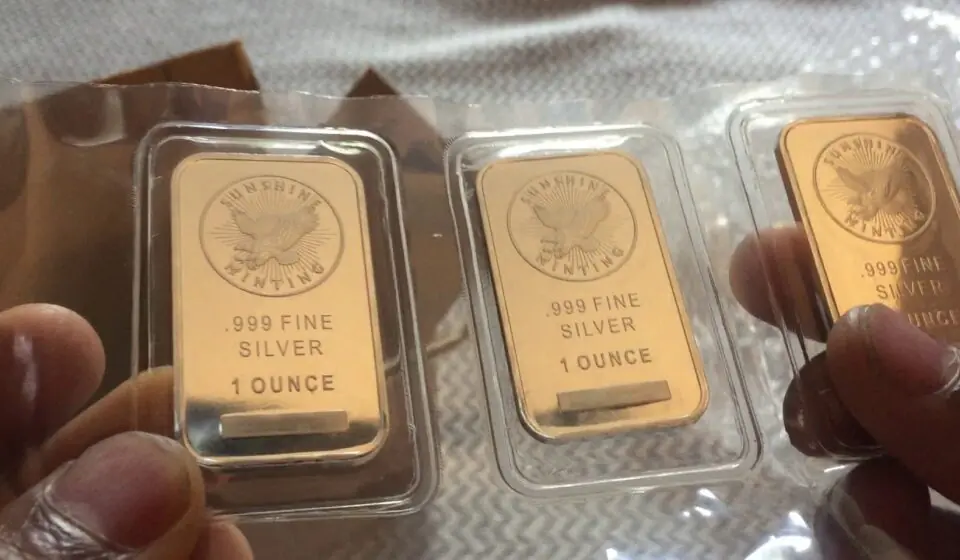
Private mints — Highland, Sunshine, Engelhard heritage brands — produce 1 oz rounds and 10 oz / 1 kg bars with no sovereign guarantee. Their premiums run $10–$20 below government coins because they lack legal-tender status and the associated seigniorage costs. A 1 oz generic round might carry a +$28 premium at the same $2,350 spot.
The trade-off is liquidity. A generic round sells at a wider bid-ask spread when you exit. Buyback bids often sit at spot or slightly below, whereas government coins command spot plus a meaningful bid premium. For a buy-and-hold allocator planning a multi-year horizon, the lower entry premium can outweigh the exit friction. For tactical positions or potential near-term liquidation, government coins typically win on round-trip cost.
Fractional vs. Full Ounce
Fractional coins (1/10 oz, 1/4 oz, 1/2 oz) carry disproportionately higher premiums per ounce. A 1/10 oz Eagle often trades at a +$120 premium per ounce equivalent — nearly triple the 1 oz premium. The minting cost per unit is similar, but spread over less gold. For investors focused on minimizing cost basis, full-ounce units or larger bars are mathematically superior.
The fractional premium exists for a reason: divisibility. A 1/10 oz coin lets you liquidate $235 instead of $2,350. That flexibility has value, but it comes at a steep price. If your allocation plan never requires partial sales, the fractional premium is deadweight cost. Many investors split the difference — core position in 1 oz coins or 10 oz bars, a small sleeve of fractionals for granularity.
Volume-Based Pricing Tiers and Breakpoints
Published Quantity Breaks
JM Bullion publishes tiered pricing on most product pages. A typical structure for 1 oz Maple Leafs might look like:
| Quantity | Premium per oz |
|---|---|
| 1-9 | +$42 |
| 10-19 | +$39 |
| 20-49 | +$36 |
| 50+ | +$33 |
The breakpoints are hard thresholds. Buying 9 coins costs $42 × 9 = $378 in total premium. Buying 10 coins drops the premium to $39 × 10 = $390 — only $12 more for an extra ounce of gold. The marginal cost of that 10th coin is effectively spot + $39, not spot + $42.
This step-function pricing creates obvious optimization points. The jump from 9 to 10 units saves $3 per ounce on the entire lot — $27 total — while adding one more ounce. The jump from 19 to 20 saves another $3 per ounce across 20 units. Smart allocators build orders to land exactly on tier thresholds when capital permits.
Planning Orders Around Tiers
If your target allocation is 15 oz, you face a choice: buy 15 at the 10–19 tier (+$39) or split into two orders (10 at +$39, 5 at +$42). The blended premium favors the single 15-coin order. But if you only have capital for 9 oz today and expect to add 6 oz next month, the math changes — you pay the higher tier now but avoid market risk on the remaining 6 oz.
Concrete scenario: You want 10 oz of gold. Option A: ten 1 oz Maple Leafs at +$39 = $390 total premium. Option B: one 10 oz generic bar at +$38 = $380 total premium. Option B saves $10 and reduces the number of line items to track. The trade-off: the bar lacks the immediate recognizability and liquidity of government coins. In a stressed market, the bar may require assay verification; the Maple Leaf does not.
Institutional-Size Orders
Orders above 500 oz (roughly $1.1M at $2,350 spot) move into wholesale desk territory. JM Bullion’s institutional team quotes custom spreads based on the LBMA good-delivery bar market, often inside the published retail tiers. These orders settle via wire with same-day price locks — a different workflow than the retail cart.
For context, a 400 oz good-delivery bar trades at a wholesale spread of $0.50–$1.00 over spot. The retail premium stack — minting, distribution, dealer margin — accounts for the remaining $30–$40. Institutional buyers effectively bypass the retail stack, accessing pricing closer to the LBMA fix. Individual investors rarely reach this threshold, but knowing it exists frames the retail premium as a service fee for fractional access, not an arbitrary markup.
Bid-Ask Spread Dynamics on Buy vs. Sell Orders
The Buy Side: What You See Is What You Pay
When you click “Add to Cart,” the price displayed includes the full retail premium. There is no hidden commission; shipping and insurance are itemized separately. The effective bid-ask spread on the buy side equals the premium over spot plus any shipping cost allocated per ounce.
This transparency contrasts with some competitors who advertise “low premiums” but add checkout fees, mandatory insurance surcharges, or minimum order thresholds that effectively raise the all-in cost. JM Bullion’s cart shows the final number before payment method selection — credit card orders may incur a 2–3% processing surcharge, but that is disclosed upfront.
The Sell Side: Buyback Pricing
JM Bullion publishes a separate “Sell to Us” price for each product. This is the dealer’s bid. The spread between the retail ask (buy price) and the buyback bid represents the round-trip cost. For a 1 oz Maple Leaf at $2,350 spot:
- Retail ask: $2,350 + $42 = $2,392
- Buyback bid: $2,350 + $28 = $2,378
- Round-trip spread: $14 per ounce (0.59% of spot)
That $14 is the friction cost of liquidity. Compare it to a local coin shop that might offer spot + $15 on the buyback — the online dealer’s scale often narrows the spread by $5–$10 per ounce. The published bid also eliminates negotiation asymmetry; you know the price before you ship.
Product Liquidity Hierarchy
Government coins enjoy the tightest buyback spreads because they’re universally recognized. Generic rounds and obscure private-mint bars can see buyback discounts of $5–$15 below spot, widening the round-trip spread to 1.5% or more. If resale flexibility matters, stick to Eagles, Maple Leafs, Krugerrands, and Philharmonics.
The hierarchy extends to bar sizes. A 10 oz generic bar from a recognized refiner (Asahi, Johnson Matthey, PAMP Suisse) typically commands a better buyback bid than an obscure 1 kg bar. Hallmark recognition drives secondary market depth. JM Bullion’s buyback list reflects this — they publish bids only for products they actively make a market in. Products not listed may still be accepted but at negotiated prices, often wider spreads.
Live Price Updates and the Sunday Evening Lock Window
The 23/5 Trading Cycle
JM Bullion’s feed follows the COMEX Globex session: live from Sunday 6:00 p.m. ET through Friday 5:00 p.m. ET. During the 45-minute daily settlement (5:00–5:45 p.m. ET), the feed freezes at the settlement price. Weekend gaps — when major news hits between Friday close and Sunday open — are absorbed into the Sunday 6:00 p.m. reopen print.
This schedule mirrors the professional wholesale market. The COMEX front-month contract trades 23 hours a day, five days a week. The Sunday reopen is the first price discovery moment after a 48-hour information vacuum. Any macro event — non-farm payrolls surprise, Fed emergency meeting, geopolitical escalation — gets priced in at that moment.
Why Sunday 6:00 p.m. ET Matters
The Sunday reopen is the first opportunity to lock a price after a weekend catalyst: a Fed speech, geopolitical escalation, or currency intervention. The spread at reopen can be wider for the first 15–30 minutes as liquidity providers rebalance. By 6:30 p.m. ET, spreads typically normalize.
Concrete example: Friday afternoon, gold closes at $2,350. Over the weekend, the Fed signals an emergency rate cut. Sunday 6:00 p.m. ET, the feed reopens at $2,385. An investor who placed a $50,000 order at 6:05 p.m. ET locked $2,385 + premium. Had they waited until Monday 8:00 a.m. ET, the price might have gapped to $2,410. The Sunday lock saved $25/oz × 20 oz = $500.
The Sunday window also matters for risk management. If you have a target entry price and the market gaps through it over the weekend, the Sunday reopen is your only chance to execute before Monday’s session potentially extends the move. Professional traders monitor the Globex reopen religiously; retail investors using JM Bullion’s feed have the same access.
Intraday Refresh Rate
During market hours, the spot feed refreshes every 3–5 seconds. The premium layer is static until JM Bullion updates its wholesale cost — typically once per business day, sometimes intraday during extreme volatility. The cart displays a timestamp: “Price locked for 10 minutes.” After 10 minutes of inactivity, the order refreshes to the current spot.
This two-speed structure — dynamic spot, sticky premium — means your all-in price moves almost entirely with the futures market during the session. Premium changes are rare and usually announced via site banner or email to account holders. During the March 2020 COVID volatility spike, some dealers widened premiums by $10–$20 intraday; JM Bullion adjusted once daily, providing more predictability.
Locking In a Price Before Funds Settle
The 10-Minute Cart Lock
When you proceed to checkout, JM Bullion grants a 10-minute price guarantee. The spot component is frozen; the premium is fixed. You must complete the payment step within that window. If the session times out, the cart recalculates at the new spot.
Ten minutes is tight. It forces preparation: have your payment details ready, know your shipping address, decide on insurance options. The clock starts when you hit “Checkout,” not when you load the cart. A practical workflow: build the cart, verify quantities and tiers, then hit checkout only when you’re ready to complete the transaction in one sitting.
Payment Method Settlement Timelines
| Method | Price Lock Held | Funds Settle | Risk |
|---|---|---|---|
| Credit/Debit Card | 10 min | Instant | None |
| Bank Wire | 10 min | 1-2 business days | Spot moves during transit |
| Paper Check | 10 min | 5-7 business days | High spot drift risk |
| ACH / eCheck | 10 min | 2-3 business days | Moderate spot drift risk |
Wire Transfer Best Practice
For orders above $10,000, wire is the only method that avoids the 2–3% card processing surcharge some dealers pass through. Initiate the wire before you hit checkout. Once the cart locks, you have the 10-minute window to send the wire reference number. JM Bullion’s compliance team matches the inbound wire to the order; the price remains locked even if the wire arrives next morning.
Risk Warning: If you lock a price at $2,350 and the wire settles two days later at $2,300, you still pay $2,350. The lock protects the dealer, not you. Only lock when you’re comfortable with the price and can fund immediately.
This asymmetry is standard across the industry. The price lock is a firm commitment — you get price certainty, the dealer gets order certainty. If spot moves in your favor after locking, you cannot renegotiate. If it moves against you, the dealer cannot ask for more. The 10-minute window is the only period where either party can walk away without penalty.
For large wires, coordinate with your bank’s cut-off times. A wire initiated after 3:00 p.m. ET may not leave until the next business day. JM Bullion’s lock holds regardless, but you want the reference number in their system within the 10-minute window. Some investors pre-stage wire templates with their bank for recurring allocations, reducing friction to a few clicks.
Buyback Pricing Compared to Local Coin Shops
Transparency Advantage
JM Bullion publishes buyback prices online for every product they carry. A local shop typically quotes verbally, and the bid can vary by customer, inventory need, and the owner’s mood. The published bid creates a floor — you know the minimum you’ll receive before shipping.
This transparency is structural. Online dealers operate on volume and published spreads; their buyback bid is a known quantity. Local shops operate on negotiation and inventory turnover. A shop heavy on Eagles may bid aggressively for Maple Leafs to diversify; a shop light on cash may widen spreads across the board. The published online bid removes that variability.
Shipping and Insurance Costs on the Sell Side
When you sell to JM Bullion, you pay shipping and insurance to them (typically $25–$40 for a 10 oz package via USPS Registered Mail). The buyback quote is net of that cost. A local shop pays you cash in hand — no shipping deduction. On small lots (under 5 oz), the shipping cost can erase the online spread advantage. On larger lots, the tighter bid usually wins.
Example: Selling 10 oz Maple Leafs. Online bid: spot + $28 = $2,378/oz. Shipping/insurance: $35 total. Net: $23,745. Local shop bid: spot + $20 = $2,370/oz cash. Net: $23,700. Online wins by $45. At 2 oz: Online net $4,721; Local net $4,740. Local wins by $19. The crossover sits around 4–5 oz depending on exact shipping quotes.
Settlement Speed
JM Bullion issues payment via check or bank wire within 1–2 business days of receiving and verifying the shipment. Local shops pay instantly. If you need liquidity today, the local shop wins. If you can wait 48 hours, the online bid often nets more after all costs. The verification step is non-negotiable — coins are weighed, measured, and authenticated against known specifications. Counterfeit detection is rigorous; any discrepancy triggers a hold and potential return at your expense.
Common Mistakes That Increase Your Cost Basis
Chasing the Lowest Premium Without Checking Buyback
A generic round at +$28 looks cheaper than a Maple Leaf at +$42. But if the round’s buyback is spot – $5 while the Maple Leaf bids spot + $28, the round-trip spread on the round is $33 vs. $14 on the Maple Leaf. Over multiple cycles, the “cheaper” product costs more. Always model round-trip, not entry only.
Ignoring Volume Tiers
Buying 9 coins at +$42 instead of 10 at +$39 costs an extra $27 in premium for one less ounce. The marginal cost of the 10th coin is spot + $39 — effectively a discount relative to the first nine. If capital constraints force sub-tier orders, that’s reality. But if you have the liquidity and skip the tier, you’re leaving basis points on the table.
Locking Price Before Funding Is Ready
The 10-minute lock is a commitment. Locking at $2,350, then scrambling to initiate a wire that misses the bank’s cut-off, leaves you exposed to a weekend gap if the wire doesn’t leave until Monday. The dealer holds your price; you hold the market risk. Only lock when the funds are staged and the wire template is ready to send.
Overweighting Fractionals for “Flexibility”
A sleeve of 1/10 oz Eagles at +$120/oz equivalent adds $780 in premium per ounce of gold versus 1 oz Eagles at +$42. That flexibility costs 3.3% of the metal value upfront. Unless you have a specific, near-term need for granular liquidation (e.g., planned partial distributions from an IRA), the math rarely justifies it.
Not Comparing All-In Cost Across Dealers
JM Bullion’s premium may be $2 higher than a competitor, but if the competitor charges $15 shipping and JM Bullion offers free shipping over $199, the all-in flips. Always compare: (spot + premium) × quantity + shipping + insurance + payment surcharge. The lowest premium does not guarantee the lowest total cost.
Frequently Asked Questions
How often does JM Bullion update its spot price feed?
The feed refreshes every 3–5 seconds during COMEX Globex trading hours (Sunday 6:00 p.m. ET through Friday 5:00 p.m. ET). It freezes for 45 minutes daily at 5:00 p.m. ET for settlement. The premium layer updates typically once per business day, sometimes intraday during extreme volatility.
What happens if the spot price moves while my order is in the cart?
The cart displays a 10-minute price lock once you proceed to checkout. Before checkout, the price refreshes to current spot after 10 minutes of inactivity. During the 10-minute checkout window, both spot and premium are frozen.
Can I negotiate premiums on large orders?
Published tiers top out at 50+ units for most retail products. Orders above 500 oz (approximately $1.1M at current spot) route to the institutional desk, which quotes custom spreads based on LBMA good-delivery pricing. Those spreads are typically inside the best published retail tier.
Why is the buyback price lower than the retail ask?
The spread covers the dealer’s market-making risk, operational costs (verification, vaulting, hedging), and profit margin. Government coins have the narrowest spreads ($10–$15 round-trip) because they’re fungible and liquid. Generic products carry wider spreads ($30–$50+) due to lower secondary market depth.
Does JM Bullion charge a commission on top of the premium?
No. The displayed price includes the full premium. Shipping and insurance are itemized separately. Credit/debit card orders may incur a 2–3% processing surcharge disclosed at checkout. Bank wires, checks, and ACH have no additional fee.
How long does a bank wire take to settle?
Typically 1–2 business days. The 10-minute price lock holds regardless of settlement timing. Initiate the wire before checkout and provide the reference number within the lock window. The price is honored even if funds arrive the next morning.
What if I lock a price and spot drops before my wire settles?
You still pay the locked price. The price lock is a binding commitment — it protects the dealer from adverse selection. Only lock when you are comfortable with the level and can fund immediately.
Are buyback prices guaranteed?
Published buyback prices are firm bids for products in original packaging, meeting weight and purity specifications. Coins with damage, excessive wear, or authenticity concerns may be adjusted or rejected. The quote is valid for the business day; it refreshes with the spot feed.
Can I sell products I didn’t buy from JM Bullion?
Yes. The buyback program accepts eligible products regardless of original purchase source. The bid is the same. You pay shipping and insurance to their depository.
What payment methods avoid the card surcharge?
Bank wire, paper check, and ACH/eCheck avoid the 2–3% card processing fee. Wires are fastest for large orders; checks and ACH add 2–7 business days of settlement drift risk.
Conclusion
JM Bullion’s pricing engine is transparent by design: a live COMEX spot feed, fixed dollar premiums by product, published volume tiers, and posted buyback bids. The investor who reads the feed correctly — locking on Sunday reopen after a weekend catalyst, hitting the 10-tier breakpoint instead of stopping at 9, choosing a Maple Leaf over a generic round for the tighter round-trip — captures basis points that compound across an allocation’s lifetime.
The mechanics are not opaque. Spot is the market’s number; premium is the product’s number; volume tier is your number. Control what you can: product selection, order sizing, timing of the lock, payment method readiness. Accept what you cannot: the COMEX print, the mint’s fabrication charge, the 10-minute checkout window.
Physical gold allocation is a long-horizon decision. A $14 round-trip spread on a 1 oz Maple Leaf is 0.59% of spot — trivial over a five-year hold, material over a five-week trade. Match your execution discipline to your time horizon. The pricing engine rewards the prepared.
—
This article is for educational purposes only and does not constitute investment advice. Trading and investing carry risk of loss; never invest more than you can afford to lose.
Last reviewed: August 2026