
Table of Contents
- What an Auto Trader Actually Does vs Manual Stock Trading
- How Auto Trading Systems Execute Orders
- The Discretionary Trader’s Toolkit
- Backtesting and Historical Strategy Validation
- When Automation Outperforms Manual Trades
- When Discretionary Skill Still Wins
- Risks Unique to Auto Trading
- Building a Hybrid Workflow That Makes Sense
- Frequently Asked Questions
- Conclusion
What an Auto Trader Actually Does vs Manual Stock Trading
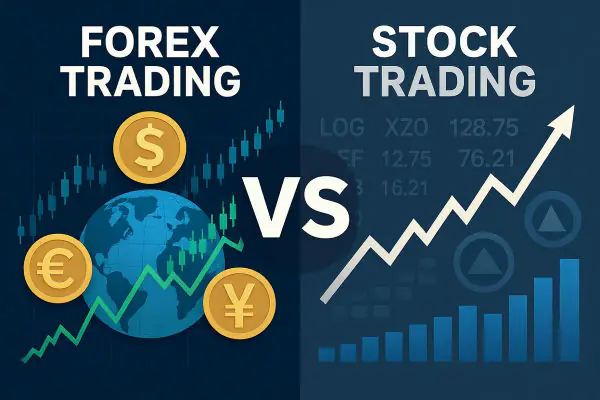
The split-screen tells most of the story. On one side, a retail investor watches QQQ tick higher into the close and decides, almost on instinct, to add to a position she has held for two years. On the other, another trader has coded a 20/50-day moving average crossover into an auto trader linked to her brokerage account, and the system quietly exits the same ETF overnight when momentum breaks.
Both approaches are legitimate stock trading. Both can produce returns. They are not the same animal.
An auto trader is software that places buy and sell orders on a stock or ETF based on rules a human has written in advance. Once the rules are set, the system scans price, volume, or indicator data continuously and routes orders to a connected brokerage automatically. No screen-watching required. Discretionary trading leaves every decision in the hands of a person: when to enter, how to size, where to cut a loss, and when to take profit.
The distinction matters because markets reward different skills at different times. Automation shines when rules are clear, signals are repeatable, and emotions are the enemy. Discretionary judgment shines when information is messy, catalysts arrive without warning, and a model has never seen the current setup before. Knowing which mode to deploy, and when, is where the real edge lives.
A useful way to frame the comparison is to look at each approach through the same lens: how decisions are made, how trades are executed, and how the trader interacts with risk.
| Dimension | Auto Trader | Manual Stock Trading |
|---|---|---|
| Decision source | Pre-written rules executed by software | Human judgment in real time |
| Speed of execution | Milliseconds, including after-hours triggers | Seconds to minutes, depending on the trader |
| Emotional exposure | Removed from individual trades | Present on every entry and exit |
| Best environment | Liquid instruments, repeatable signals, trend or mean-reversion regimes | Catalyst events, thin liquidity, regime change |
| Failure mode | Model decay, overfitting, connectivity loss | Hesitation, revenge trading, fatigue |
| Required skills | Coding, statistics, data hygiene | Tape reading, sizing, macro context |
The rest of this article walks through each side of that table in greater detail.
How Auto Trading Systems Execute Orders
Algorithmic Order Execution Rules
At the heart of every auto trader sits a rule set, usually written in plain logic or a lightweight scripting language. The rules typically reference price action, technical indicators, or live data feeds. A simple example: “Buy 100 shares of SPY when the 9-period RSI crosses below 30, and sell when it crosses above 50.”
Once triggered, the auto trader formats the order as a market, limit, or stop instruction and sends it to the connected broker. Execution happens in milliseconds, often faster than a human could click “confirm.” That speed is a genuine advantage in fast-moving names, where bid-ask spreads widen and slippage can quietly eat into returns.
In practice, most retail auto traders run one of three execution styles:
– Event-driven systems that act on a single trigger, such as a breakout above a defined resistance level.
– Signal-based systems that combine multiple indicators before sizing a position.
– Rebalancing bots that periodically restore a target allocation across a portfolio of stocks or ETFs.
Each style has its own risk profile. Event-driven systems tend to whipsaw more often in choppy conditions. Signal-based systems reduce false signals but can be slower to react. Rebalancing bots are steady by design but can underperform in strong directional markets if they rebalance too aggressively.
Brokerage API Integration and Order Routing
For an auto trader to actually place a trade, it needs a bridge to a brokerage. Brokers like Interactive Brokers, Alpaca, and TradeStation publish application programming interfaces (APIs) that allow third-party software to send authenticated orders. The auto trader authenticates, formats an order ticket, and the broker routes it to an exchange or wholesaler for execution.
This infrastructure is regulated. In the U.S., the SEC and FINRA oversee broker-dealers and the routing of customer orders, and brokers are required to seek best execution reasonably. From an investor’s perspective, an order placed by an auto trader goes through the same compliance and surveillance pipeline as one placed by hand.
API integration also enables pre-trade risk checks. The auto trader can refuse to send an order if the position would exceed a defined size, if the account lacks buying power, or if the price is too far from the last quote. Those guardrails explain why professional desks lean on automation; the system enforces discipline that humans forget during volatility spikes.
The Discretionary Trader’s Toolkit
Discretionary trading is not the same as uninformed guessing. A skilled discretionary trader builds a workflow around information flow, catalyst calendars, and real-time tape reading. The toolkit typically includes:
– A charting platform with Level II quotes and time-and-sales data
– An earnings calendar to anticipate volatility events
– A position-sizing model, often a fixed-fraction or volatility-adjusted approach
– A pre-defined stop placement rule, even if the entry is judgment-based
The core of discretionary work is context. Consider a trader holding NVDA into an earnings release. The discretionary trader is watching implied volatility, open interest on options, and historical gap behavior. If implied vol is rich relative to the expected move, she might trim size or buy a hedge. If it is cheap, she might add. None of that is a rule. It is reading.
That flexibility is the defining feature. A human can decide to pass on a setup that looks technically correct because the market feels fragile, or lean in because the tape confirms the thesis. No coded system, however well backtested, can replicate that judgment on demand.
Discretionary traders also tend to weigh information that does not show up in price series: management tone on a conference call, a sudden change in a competitor’s pricing, an analyst downgrade that has not yet been priced. Some of that data can be scraped or fed into an algorithm, but the interpretive layer remains human.
Backtesting and Historical Strategy Validation
Before an auto trader goes live, the strategy is almost always tested against historical data. Backtesting runs the rules across years of price action to estimate how the system would have performed, including drawdowns, win rate, and average trade duration. For a retail investor, it is the closest thing to a research lab.
Done correctly, backtesting is powerful. It reveals whether a moving average crossover actually captured trends in the past, or whether a mean-reversion rule quietly bled capital during trending markets. Done poorly, it is dangerous. Overfitting, survivorship bias, and look-ahead errors can make a useless strategy look like a money printer.
> Backtested results never guarantee future performance. A strategy that worked during a low-rate, low-volatility decade can collapse the moment the regime changes.
Most credible auto trading platforms include transaction costs and slippage in backtests. Some allow walk-forward analysis, where the model is trained on one window and tested on the next. For a beginner, the practical rule is simple: if the only way a strategy looks good is by ignoring commissions and gaps, the strategy is not actually good.
A few checkpoints improve the integrity of any backtest:
– Use out-of-sample data the system was not optimized on
– Include realistic slippage and financing costs
– Test across multiple market regimes, including rising-rate, falling-rate, and high-volatility periods
– Track drawdown depth and recovery time, not just total return
A backtest that shows a 40% annualized return with a 5% maximum drawdown is far more credible than one showing 90% returns with a 40% drawdown, even if the second number looks more impressive on a marketing page.
When Automation Outperforms Manual Trades
Automation earns its keep in three situations that recur across cycles.
1. Trend-following on liquid instruments. A 20/50-day moving average crossover on QQQ is a textbook example. The rules are mechanical, the signal is objective, and the asset trades millions of shares a day with tight spreads. During the 2023 AI-driven rally, an auto trader configured to ride the trend would have stayed long through the move and exited automatically when the fast average crossed below the slow one, capturing a meaningful portion of the advance without the trader staring at screens.
2. Volatility-driven rebalancing. When the VIX spikes, discretionary traders often freeze. An auto trader, by contrast, can rebalance to target weights, harvest tax losses, or rotate into defensive sectors without hesitation. Speed and consistency matter most when sentiment is fragile.
3. Removing behavioral error. Cutting losses is hard. So is taking profit before a runner extends. Automation executes the plan a trader would write down if they were calm, but rarely follow when adrenaline is high. That behavioral discipline is one of the most underrated features of systematic trading.
When Discretionary Skill Still Wins
For all the appeal of automation, there are setups where a human trader still has the edge.
Binary catalyst events. Earnings, FDA decisions, and macro releases create overnight gaps that no intraday rule can anticipate. A discretionary trader who sizes positions around implied volatility crush, or who watches the order book into the open, can react in ways an algorithm cannot without being explicitly programmed to do so. Watching NVDA ahead of a print, scaling based on the gap, and placing a limit order on the open is a discretionary skill that algorithms without the same context often miss.
Regime changes. When a central bank pivots, when a new asset class emerges, or when correlations break down, historical patterns become less reliable. Discretionary traders who recognize the shift can cut exposure or rotate early. A backtested auto trader running the same old rules will often perform poorly until it is retrained on the new environment.
Thin liquidity and small caps. Automation in illiquid names is risky. Wide spreads, gap risk, and low volume punish auto traders that assume normal market conditions. A discretionary trader can choose to stay flat, size smaller, or demand a wider reward-to-risk setup before engaging.
Risks Unique to Auto Trading
Auto trading carries risks that do not exist, or exist in a milder form, in manual trading.
Model risk. The coded rule is only as good as the logic behind it. A bug, a missing condition, or an out-of-sample shock can produce losses that the human never intended.
Connectivity risk. APIs go down. Brokers go down. Internet goes down. An auto trader that cannot reach its broker may fail to flatten a position during a crash, leaving the trader exposed overnight. For this reason, many retail auto traders run their systems on a virtual private server rather than a personal laptop.
Over-optimization. A strategy tuned to fit ten years of history perfectly may be perfectly unfit for the next ten. The more parameters a system has, the easier it is to overfit.
Compliance risk. Even for retail traders, FINRA and the SEC require that automated orders comply with market-access rules, including pre-trade risk checks. Brokers enforce this on their end, but the trader remains responsible for the strategy.
> Automation does not remove responsibility. It moves the burden from in-the-moment decisions to the design, testing, and ongoing maintenance of the system.
For a retail investor, the practical implication is to start small, monitor every trade for the first few weeks, and keep kill switches that pause the system if drawdowns exceed a defined threshold. Logging every order, including rejected ones, also helps when something goes wrong and the trader has to reconstruct what happened.
Building a Hybrid Workflow That Makes Sense
The cleanest mental model is that auto trading and discretionary trading are tools, not identities. The most resilient retail investors tend to use both.
A workable hybrid might look like this:
– Core sleeve: Long-term, low-turnover positions in broad ETFs, held discretionarily and rebalanced manually.
– Systematic sleeve: A trend-following or mean-reversion auto trader applied to a liquid subset of holdings, used to manage entries and exits.
– Catalyst sleeve: Discretionary trades around earnings, macro events, or sector rotations, sized smaller because the edge is judgment-based.
The advantage of the hybrid is risk diversification. If a discretionary call goes wrong, the systematic sleeve is still running its rules. If the auto trader hits a rough patch because of a regime change, the discretionary sleeve can be dialed down or hedged manually.
Capital allocation matters. Most practitioners keep the systematic sleeve to a percentage of total equity they can stomach seeing draw down 15% to 25% in a bad month, because trend-following systems in particular are designed to give back gains during choppy markets. The discretionary sleeve is sized for higher conviction, but with stricter stops.
Finally, the infrastructure must be boring and reliable. Choose a broker with a stable API, log every order, and run the auto trader on a dedicated machine or virtual server so a personal laptop going to sleep does not interrupt execution. Platforms like MetaTrader 5 and TradingView are common starting points, though serious automation often moves to custom Python setups once strategies grow more complex.
Frequently Asked Questions
What is an auto trader for stocks and how does it work?
An auto trader is software that places buy and sell orders on stocks or ETFs based on pre-written rules. It connects to a brokerage through an API, watches price or indicator data in real time, and routes orders automatically when conditions are met. The human sets the rules, but the system executes without manual approval.
Is auto trading more profitable than manual stock trading?
Not necessarily. Profitability depends on the quality of the strategy, the discipline of execution, and the market environment. Automation helps by removing emotional errors and enforcing rules, but it does not guarantee better returns. A well-designed system can underperform a skilled discretionary trader in choppy markets, and a discretionary trader can be outclassed by a disciplined auto trader during sustained trends.
How much money do you need to start using an auto trader?
Most retail brokers do not impose a strict minimum for API access, but most auto traders work best with enough capital to avoid pattern-day-trader restrictions and to size positions sensibly. Practically, a few thousand dollars is often the minimum to make diversification and risk control meaningful. Smaller accounts can still use auto trading on fractional share platforms, but slippage and commissions matter more at that scale.
Can auto traders lose money in a market crash?
Yes. Most trend-following systems will exit long positions as prices fall, but they can still realize losses on the way out. Mean-reversion systems can be devastated by sudden, sustained moves. Auto traders are not crash-proof; they simply follow their rules, which may or may not be appropriate for the environment. Liquidity can also disappear in a crash, leaving the system unable to exit at the intended price.
Are auto trading platforms legal for retail investors?
Yes, in regulated markets like the U.S., the U.K., and the EU. Brokers must comply with rules set by regulators such as the SEC, the FCA, and FINRA, including pre-trade risk controls. The trader, in turn, is responsible for ensuring the strategy does not violate market manipulation or wash-trade rules.
What is the best auto trader software for beginners?
There is no single best option. Beginners often start with rule-based platforms that require little or no coding, such as those offered by brokerages themselves, before moving to API-driven environments like MetaTrader 5 or custom Python setups. The right choice depends on the trader’s technical comfort, the markets traded, and the strategies being deployed.
Conclusion
Auto trading and discretionary stock trading are not rivals. They are two execution methods that solve different problems. Automation enforces discipline, scales across many instruments, and removes the emotional cost of pulling the trigger. Discretionary trading applies context, reads the tape, and adapts when the world changes in ways the backtest never saw.
For most retail investors, the highest-conviction path is to treat both as tools in a single workflow. Define a strategy, test it, deploy it through a regulated broker, and supervise it like any other investment. Conditions change, models decay, and the next regime is never identical to the last.
A practical next step: paper-trade one auto trading rule for at least a month before committing real capital, and keep position sizing small enough that a worst-case drawdown does not change your life. Markets reward patience and process, regardless of who, or what, clicks the buy button.
Further Reading
- SEC – Automated Investment Tools and Investor Protection
- FINRA – Algorithmic Trading and Market Access
- Cboe – VIX and Volatility Products
-
CME Group – Exchange-Traded Markets
This article is for educational purposes only and does not constitute investment advice. Trading and investing carry risk of loss. Past performance, including backtested results, does not guarantee future returns. Never invest more than you can afford to lose.
Last reviewed: August 2026